Colophon
- Book
- Appendix
- Sections
- 6
- Reading time
- 3 min
This is kogakure (木隠). Since 1999, this site has published articles, collections of texts, and translations about the ninja, Japan’s spies, and their martial art, ninjutsu.
The idea came from me, Stefan Imhoff, a designer, developer, and martial artist, then living in Wolfsburg, now in Hamburg. I also built it myself.
What Does 木隠 Mean?
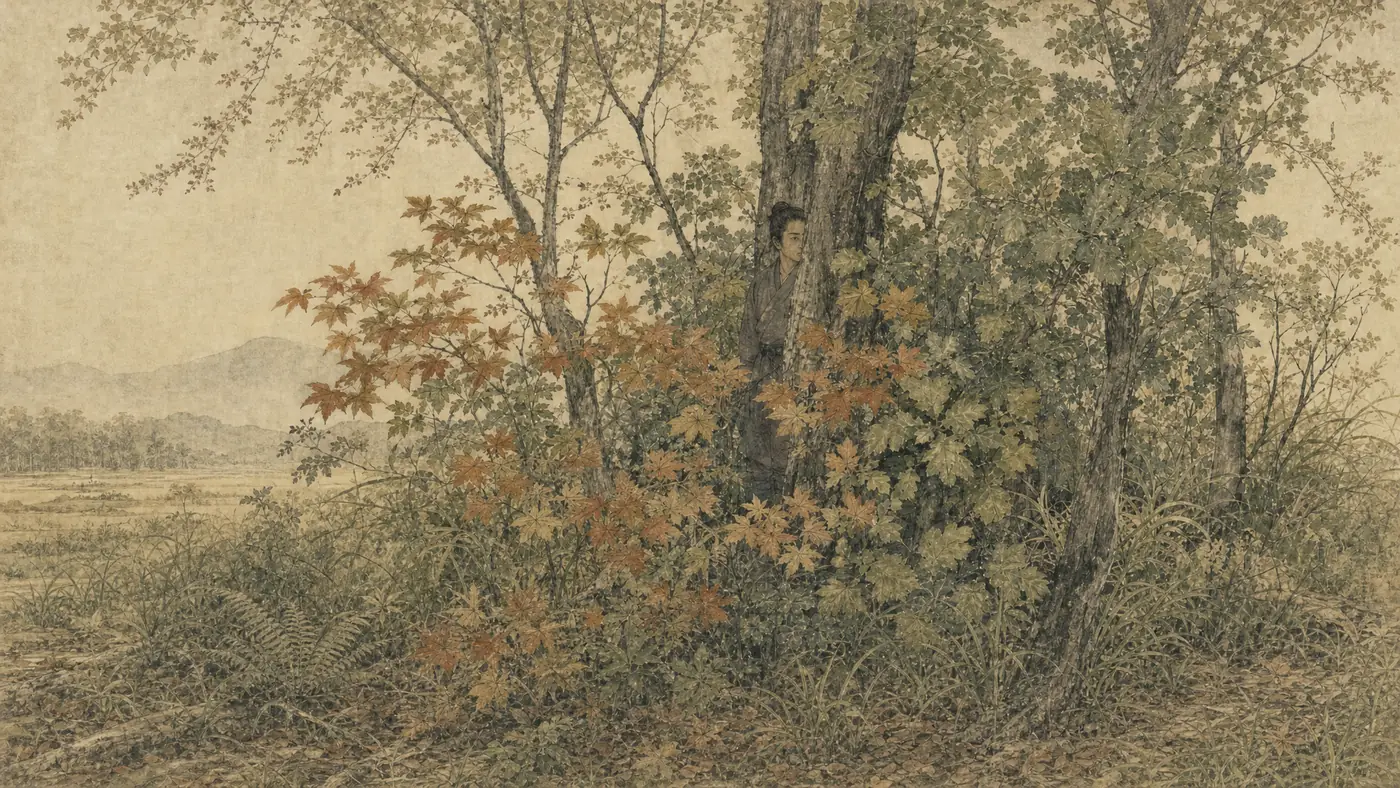
Kogakure is Japanese and translates literally as something like “hidden behind leaves and trees”
.
The name borrows from two models: the book Hagakure (葉隠, “hidden under leaves”
) by the samurai Yamamoto Tsunetomo, and one of the oldest schools in the Bujinkan, the Togakure-Ryū (戸隠流, “hidden behind a door”
).
Why Does This Book Exist?
Since the early 90s, I have been interested in the ninja and their world of ideas.
Back then the Bujinkan had barely reached Germany, and a place to train was almost impossible to find. The specialist literature on sale was meager at best.
While searching for knowledge and background, I gradually built up a collection of notes. This book grew out of it.
It does not claim to be complete, nor does it offer absolute, verifiable historical proof. It is meant to help all bugeisha 武芸者 “warriors”
learn more about the wisdom of this art, which is more than a thousand years old.
Inspiration
My picture of the ninja was shaped by the books and writings of many people. Hatsumi Masaaki, Stephen K. Hayes, and Andrew Adams influenced me the most. My thanks go to everyone whose work inspired this book: Andrew Adams, Sleiman Azizi, Peter Carlsson, Quintin Chambers, Benjamin Cole, Antony Cummins, Wolfgang Ettig, Daniel Fletcher, Steffen Fröhlich, Hatsumi Masaaki, Stephen K. Hayes, Hino Akira, Kostas Kanakis, Minami Yoshie, Stephen Turnbull, and Herbert Velte.
How This Book Was Made
In 2026 I thoroughly revised all the texts. I rewrote them together with Claude Code (Opus 5.5) and then translated them into ten more languages. I checked names, dates, characters, and terms as thoroughly as I could, with Opus 5.5 and Grok 4.6 as researchers and with sources in several languages.
Even so, I cannot rule out errors. Many sources on the ninja were written late, contradict each other, or cannot be verified. Part of their history is legend: stories that grew over centuries and are often hard to separate from fact. Where that is the case, the texts say so. If you spot a mistake, I’d be glad to hear about it.
The images are new as well. I created around 360 images with GPT Image 2 and upscaled them with Topaz Labs: about 140 new paintings for the articles and around 220 drawings that replace old photos and 3D images. The glossary has grown from just under 570 to about 760 terms.
The design is new too: Gekiga 劇画 “dramatic pictures”
. It recalls the ink prologue of a film. Each part of the book opens with a toned painting cut by a wet ink edge, with a vertical name plate in brush script on top. Then the page turns as calm as a printed book. I chose the design from more than 50 prototypes in 24 directions.
Donations
This book is free and ad-free. Over the years it has cost me many hundreds of hours of work.
If you enjoyed it, I appreciate praise and recognition. You can also support me with a small donation.
- Donate with Ko-fi
- Donate with PayPal
- Donate with Lightning:
kogakure@walletofsatoshi.com
Technical Information
If you have read this far, you are probably also interested in the technology behind this site.
For the new version I didn’t open a single graphics program or code editor. Texts, code, design, and research came out of conversations with Claude Code, the images from GPT Image 2 via Replicate. Astro generates the pages, and Tailwind CSS styles them. The typefaces are Source Serif 4, Shippori Mincho, Yuji Syuku, and IBM Plex Mono. Everything is versioned with Git. The website runs on a VPS at Hetzner, managed with Coolify.
The website comes in two modes: by day ink on washi paper, by night light pigment on indigo cloth.
The source code of this website is open to everyone on GitHub. You are welcome to report errors or suggest improvements and additions there as an issue or by email.