Iga no Ran
A castle built with the help of its enemies, and 12,000 men who attacked through three passes and failed – how Iga held out against Oda Nobunaga’s son Nobuo in 1579.
- Chapter
- 1, History
- Sections
- 3
- Reading time
- 4 min
Oda Nobunaga’s Interest in Iga
In the late 16th century, the Oda family attacked the province of Iga twice. Iga itself was not really the point; the prize was the entire Ise region. For a long time, the Kitabatake family had ruled there. The Kitabatake and the Nikki family, who governed Iga, knew perfectly well what the ninja were up to. They did not interfere, because they respected the ninja’s skills. Kitabatake Tomonori even had a castle built on Mount Maruyama in the middle of Iga to control the region from there. That never happened, probably because the people of Iga were too closely tied to the ninja families.
The story began in 1560, when Oda Nobunaga and his armies won great successes. In 1568 he marched into Kyōto and installed the last Ashikaga shōgun there. But he was still surrounded by enemies – Mōri, Takeda, and Uesugi – so he sent his troops to conquer Ise. He needed control of the Tōkaidō, the main road through northern Ise. Kitabatake Tomonori lost Kanbe Castle and Kuwana Castle. Kuwana mattered most, because from there the Tōkaidō could be defended well. Oda kept winning, took Okawachi in fifty days, and forced Kitabatake Tomonori to make peace. The condition: Kitabatake had to adopt Oda’s second son, Nobuo, who was twelve at the time.
Many territories in Ise went to Oda’s generals as a reward. Kitabatake kept his post, but only as a puppet daimyō. He was later assassinated, perhaps by Tsuge Saburozaemon, one of his former vassals. With that, control of the province passed to Oda Nobuo.
Led by Kitabatake Tomochika, the Kitabatake family gathered all their loyal samurai and supporters from Iga to take revenge on Oda Nobuo. Tomochika had been a priest in Nara and returned after Tomonori’s murder. He was reportedly supported by the son of Tsukahara Bokuden, one of the most famous swordsmen. Oda Nobuo’s general Takigawa Saburohei Kazumasu crushed the uprising. The surviving samurai fled to Iga and begged the Mōri, the family of Mōri Motonari, for help. Their region had not been involved in the fight against Oda, but their forces began to harass Oda Nobunaga. That was reason enough to move against the Mōri.
The Uprising of Iga
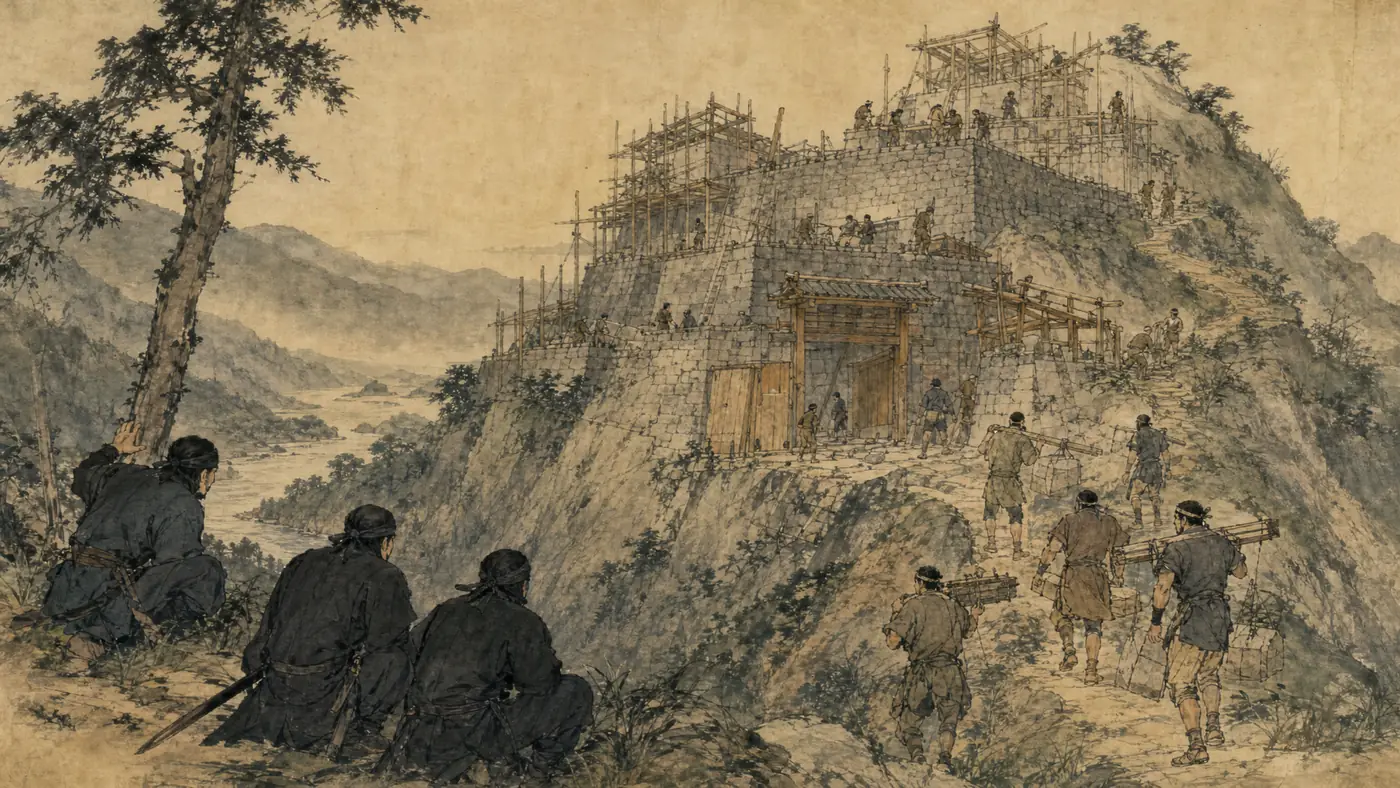
The uprising that became known as the Iga no Ran began in 1579 with a complaint: Shimoyama Kai no Kami came to Nobuo to grumble about the rest of Iga’s population. Nobuo felt he finally had a reason to prepare for war. He set out to complete the castle that his stepfather, Kitabatake Tomonori, had never finished, and ordered Takigawa Saburohei to build it on Mount Maruyama.
The castle towered 180 meters above the Hijiki River. Takigawa Saburohei planned the invasion with the help of his own ninja. But Iga had people on the building site too: many Iga ninja worked on the castle and went home knowing its weak points.
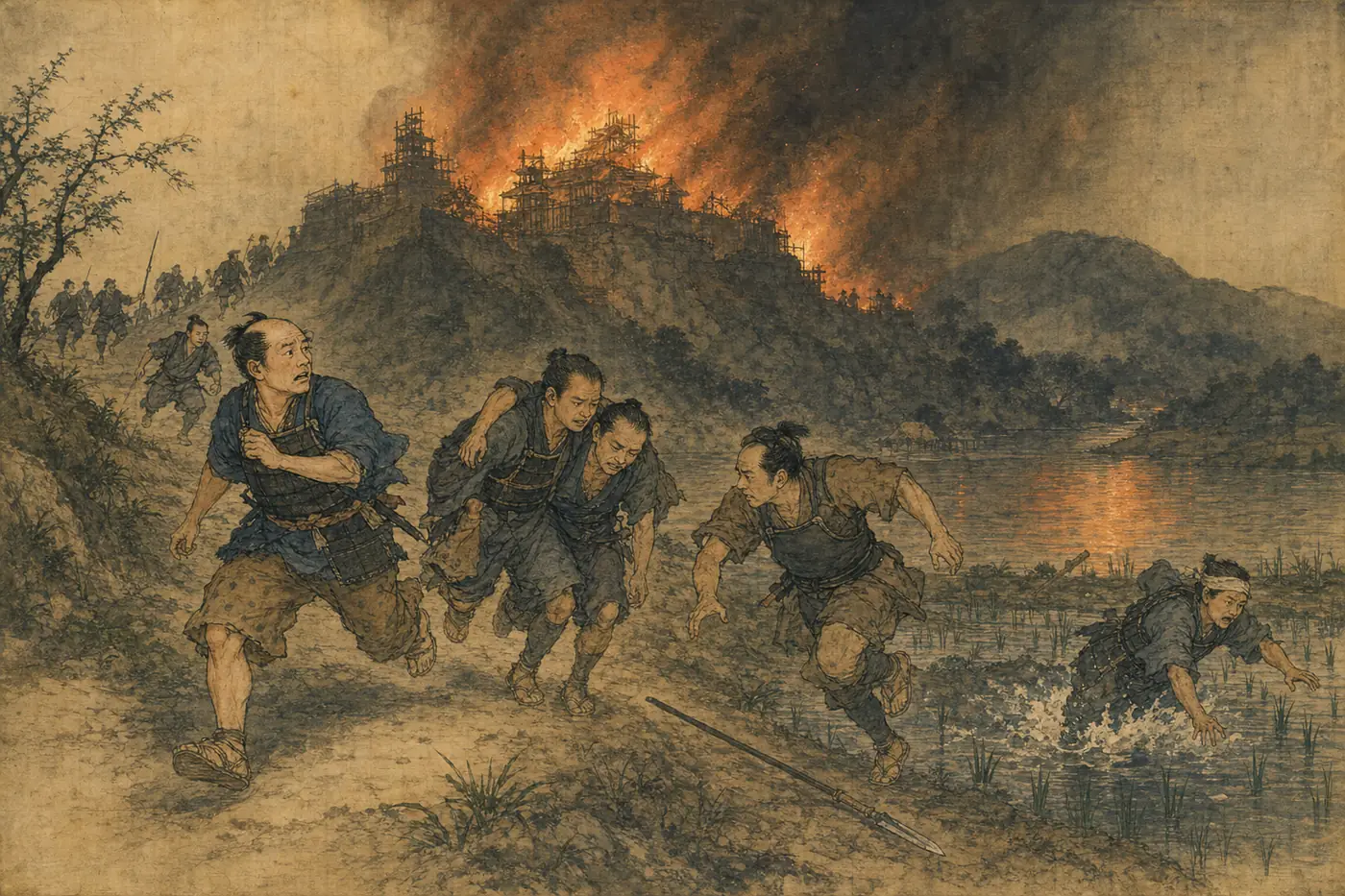
The leaders of Iga did not wait for the castle to be finished. Samurai and ninja attacked together. The unfinished castle offered no protection, so Takigawa’s soldiers fell back to the villages at the foot of the mountain, where smaller bands of samurai fell on them. Those who had barricaded themselves inside soon realized that the attackers knew exactly how to get in.
These men fled to join the rest of Takigawa’s forces. But the troops were driven into the flooded rice fields and the forests, and the fighting went on into the night until they were beaten. Takigawa himself survived and fled to Matsugashima. The next day, the ninja and samurai burned the castle to the ground.
Nobuo’s Campaign Against Iga
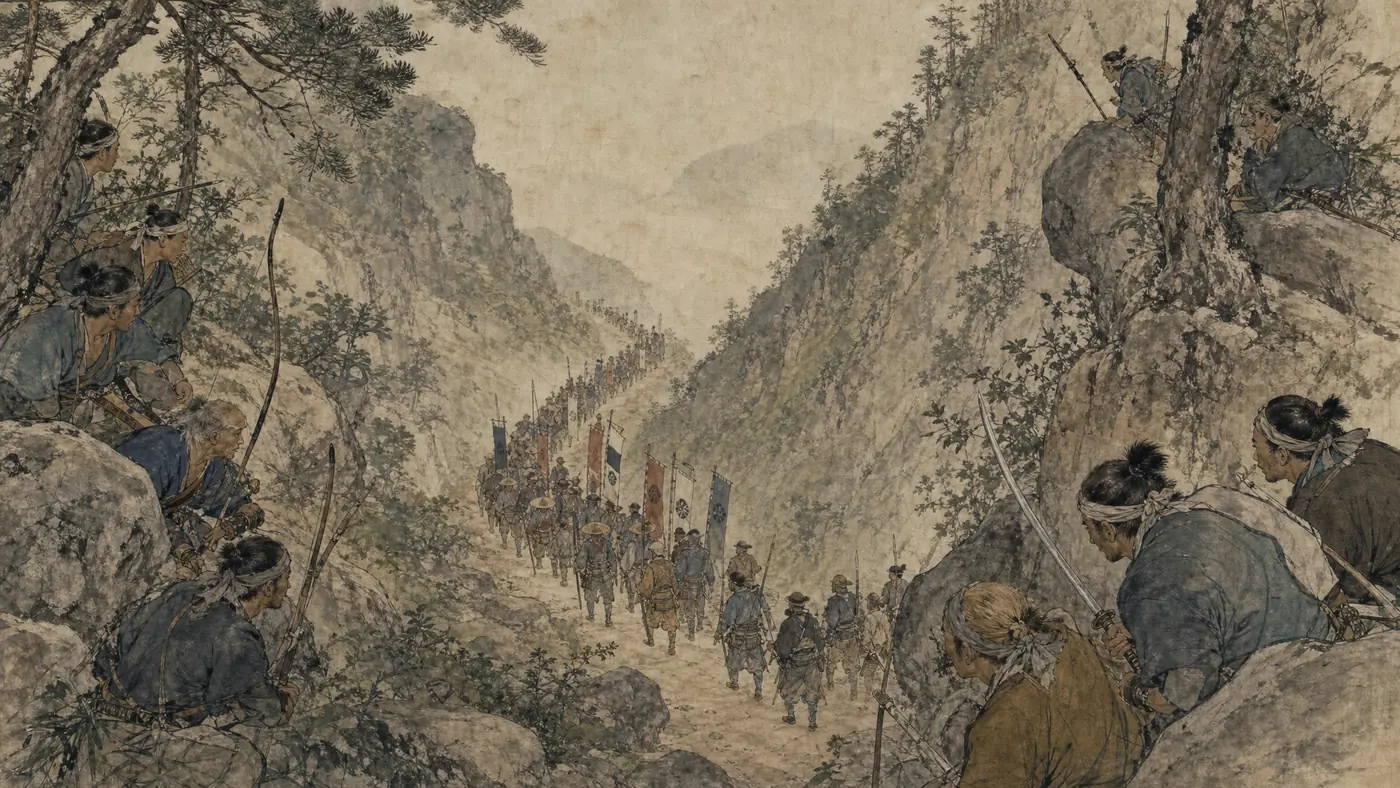
The defeat at Maruyama had cost Takigawa his honor, and he wanted revenge. When Oda Nobuo decided to conquer Iga, Takigawa backed him. Nobuo’s other vassals advised against it, but he rode into battle anyway. His plan: attack with 12,000 men through the three best passes from Matsugashima. Nobuo himself led the attack through the northern Nagano Pass. But the people of Iga had sent out their ninja, learned of the plan in time, and defeated Nobuo’s army with ease.
Takigawa came from the south through the Oniboku Goe (“Devil’s Pass”
) and was beaten in much the same way. For the Iga troops this victory had an extra edge: they could take their revenge on Tsuge Saburozaemon, who was riding with Takigawa.
The third and last attack struck between the other two. It was led by Nagano Sakyo Tayu and Akiyama Ukyo Tayu. At Iseji, their troops were lured into attacking a village. By then they had long since marched past the hidden Iga troops, who fell on them from behind, cut off every escape route, and wiped them out.
Nobuo barely escaped with his life and fled back to Matsugashima.